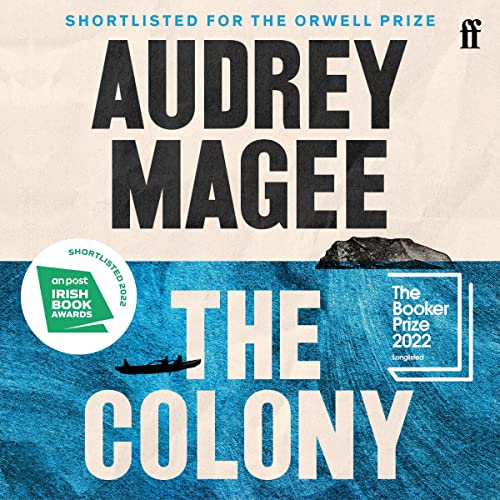
Oh my goodness, I thought this book was just fabulous! It was my book group read for March and by far my favourite book group title and audiobook title for some time. The narrator (Stephen Hogan) deserves a special mention because he was so good. Partly because his lovely soft Irish voice is very easy on the ears (even when he read the copyright notice at the end it sounded like poetry!) and also largely just the brilliant interpretation of the words written into meaning – I couldn’t fault him.
The book is both a captivatingly readable story and a richly layered metaphor – from the first chapter, where the irritable complaining Englishman is ferried by coracle to the remote Irish language speaking island where the book is mainly set felt like classical literature – I was almost screaming ‘don’t pay the ferryman’ as the journey felt like a passage to the afterlife! And I laughed out loud when the Englishman tried to get the sailors to sing as they rowed, because his guide book has told him they did that, and that was the only reason he chose to travel that way, and their response was to flat refuse and tell him he needed to get a better guide book!
The characters on the small island are given flesh and feeling as we get to know them as well as the Frenchman who visits every year to work on his PhD thesis about the erosion of the Irish language over time due to the historic English colonisation of Ireland.
The narrative is interspersed with news reports of Northern Ireland troubles atrocities – policemen shot, soldiers blown up, as well as people just caught up in bombs and shooting by being at the wrong place at the wrong time and so forth and we realise that the old lady matriarch of the island listens to the news on her radio because they sometimes discuss the stories around the kitchen table.
The Englishman is an artist who always reproduces old classic paintings, or his interpretation of them at least, one island inhabitant described him (not to his face) as a magpie – ‘it’s in his nature to steal, he doesn’t even see that he’s doing it’ (paraphrased, from memory).
A teenaged boy does odd jobs for the Englishman and becomes enamoured with the idea of becoming an artist himself, and after very reluctantly allowing him to try some sketches and then paintings, the English man sees that the boy has real talent and originality. Now the book reminded me of Mozart and Salieri – the older mentor being horrified that his young upstart apprentice’s gift far outstrips his own.
The Frenchman hates the Englishman, and as we learn his backstory, we see that his mother was Algerian and his French father was a soldier in the French Colonised Algeria when he met her and they had a child, but when he brought her back to France with him he bullied and abused her and tried to force her to fit in and abandon her Algerian Muslim heritage and become more like a French woman.
All the threads – the Englishman’s casual theft of ideas and culture, the Northern Irish troubles and the Frenchman’s backstory all illustrate the long ranging effect of colonisation – of one nation (or more than one) believing that they are better than another and entitled to take what they want.
The Englishman’s relationship with the young wannabe artist perfectly illustrates this – he shamelessly exploits the young man but when he gives him the smallest crumb of assistance he expects grovelling gratitude. When they discussed the mistreatment of the Irish by the English the Englishman genuinely still seems to believe that the ‘Empire’ helped the poor savages more than abused them and they should be grateful.
The ending was poignantly predictable but no less powerful for it. Very good book.
 Sarah Wray Writer